Law will ease care choices
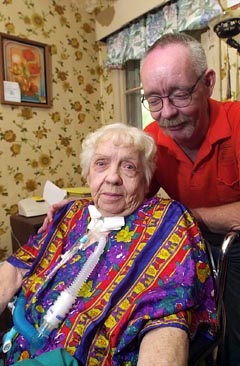 ROB BARENDSE-THE POST-STAR Betty Cranston sits with her son, David, at her Luzerne home in May after being released from a nursing home where she had been kept against her will. |
Local woman fought for right to live at home
By THOM RANDALL
randall@poststar.com
LAKE LUZERNE -- Betty Cranston put down a quilt she was sewing in her kitchen Wednesday and raised a glass of milk in a ceremonial toast.
"This new law is a real victory," the smiling 82-year-old said as she clinked glasses with her home health care aide, Candy Winslow of Queensbury. "Now maybe many more people like me can get the health care they need at home -- where they want to be."
Cranston had reason to celebrate. For about two years, she waged a legal battle to get out of a downstate nursing home where she said she was being held against her will.
In May, she was freed. She returned home to Lake Luzerne to be with her family and socialize with neighbors and church members.
Cranston needs a respirator to breathe freely.
Her battle to live at home, rather than at a nursing home, became a rallying point earlier this year for people around the state who said tens of thousands of people were facing unnecessary institutionalization. Advocates for the disabled chanted "Free Betty" at various rallies around the state, including one in February in which they seized control of Gov. George Pataki's office lobby.
On Tuesday, Pataki signed a bill into law that is intended to provide more people with the choice of staying in the "most integrated setting" -- generally at home, rather than in institutions.
The bill, which will take effect in 90 days, calls for the state to establish a policy-making council to ensure that people with disabilities can choose to live at home or in community settings rather than institutions. This coordinating council, which will include advocates for the disabled, will be required to develop a plan for the state to comply with the U. S. Supreme Court's 1999 "Olmstead" decision, which affirmed people's rights to be cared for in the most integrated or community-based setting of their choice.
Brad Williams of Queensbury, executive director of the New York State Independent Living Council, based in Albany, choked back tears Wednesday as he recalled his three-year fight to get the federal and state governments to guarantee choice for the disabled.
"This is the culmination of a lot of work." he said. "And Betty was a pioneer in this struggle to secure rights for people with disabilities. She and her son David fought for her rights and showed others what could be done to make it through the bureaucracy."
Also fighting for Cranston's right to go home were Ted Galusha of Warrensburg and Bruce Darling of the statewide Center for Disability Rights, based in Rochester.
"The fact that people rallied around Betty was heard very clearly in Albany," Darling said. "Her situation put a face on the issue, and then it stopped being about money and politics. For people with disabilities, this is the equivalent of the Emancipation Proclamation."
Darling said the decision could boost the quality of life for as many as 100,000 people statewide. And in the coming years, several times that number could benefit as baby boomers move into their sunset years, he said.
"This decision means choice and freedom for us all, to live the lives as we see fit," Darling said.
Cranston had been held by the nursing home, which received more than $300,000 a year in state Medicaid payments for her care. Advocates for her release contended the nursing home wanted to keep her against her will so it could keep this income, although nursing home officials responded that they simply were trying to ensure her health.
David Cranston is now managing her care at home, with the assistance of a half-dozen aides, at less than one-third the cost of the nursing home's care.
Although it likely will be several years before the formal process is set up to ensure the choice of community-based care, Williams said that in recent weeks, about a dozen cases similar to Cranston's have been resolved quickly.
In addition, he said, the new law likely will inspire county health departments and nursing homes to streamline the home health care certification process from now on.
Darling said other states that have enacted the community-based care initiatives have experienced great savings in Medicaid expenses.
As Cranston worked on her quilt Wednesday, she said she was not only enjoying her life at home surrounded by family but was happy she was now saving taxpayer money with at-home care.
"I am glad what I'm saving on Medicaid costs is now going to people who truly need it," she said.